Emile De Visscher writes articles, research essays and invites other practitionners to publish. The aim of these writings is to use experience from the projects and teaching to question, ground and amend current knowledge and theories on transitions, technologies, materials, and the design discipline itself.
Wherever possible, texts are available for download or in open access in the archive below, in accordance with publishers' policies.
-
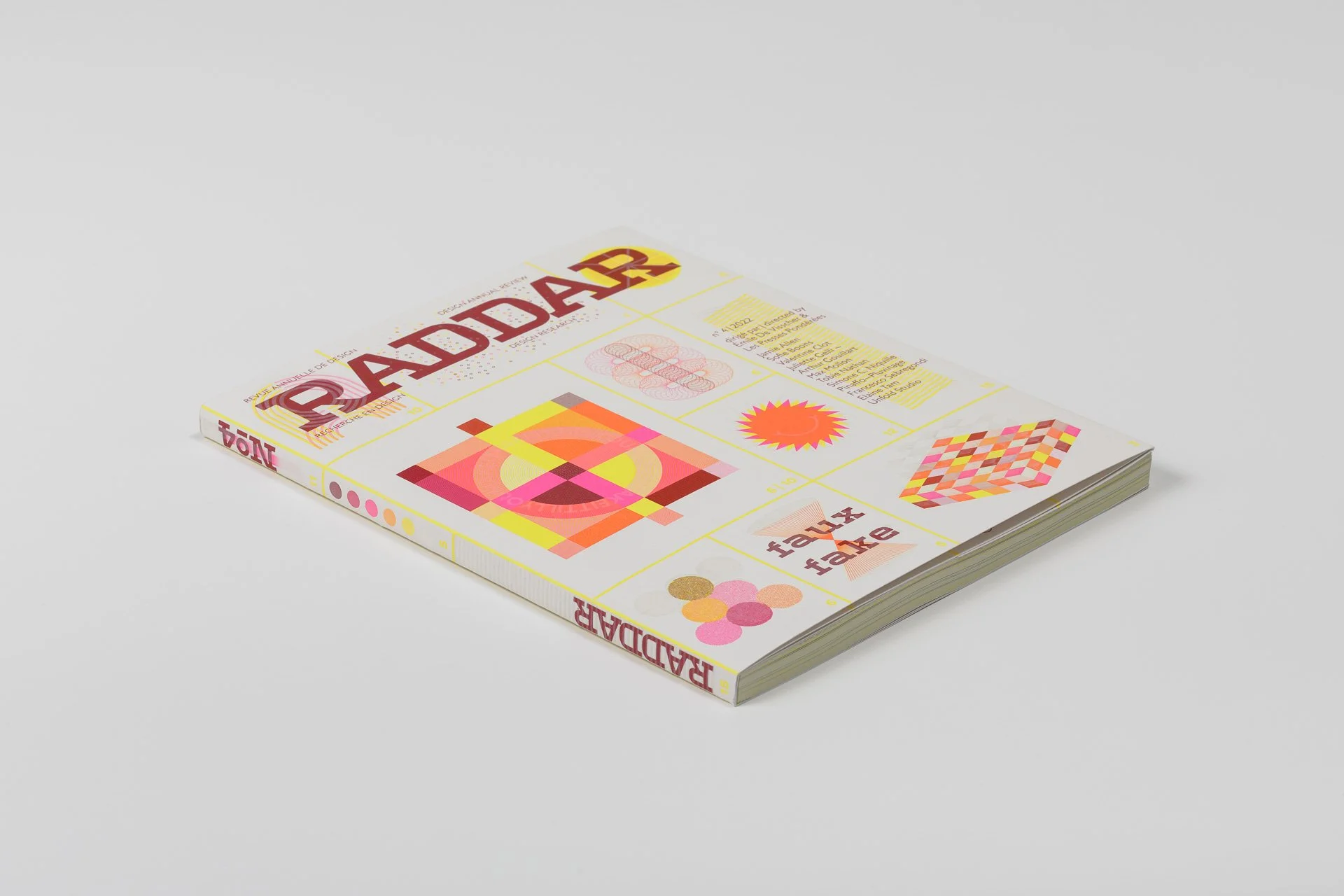
Invited by T&P WorkUnit and Mudac, Emile De Visscher and the LPP collective lead the 4th issue of RADDAR, a bilangual design research journal.
This fourth issue is composed exclusively of texts written by designers. The theme addressed, falsification, is thus rooted in practice: the authors refer to their ongoing research, investigations, and experiences with falsification and the fabrication of reality. Unlike many other disciplines, designers do not have the stated goal of seeking truths or describing facts, as physicists or historians might. Their work most often consists of producing things, in the broadest sense of the term. However, the question of authenticity is very much present, as evidenced, for example, by strategies to combat or recover from falsifications. So what is the relationship between design and fakes?
The articles in RADDAR 4 address the theme of fakes—fake materials, false needs, false nature—through original topics such as 3D digital models of destroyed collections or cultural heritage assets, the relationship between design and artificial gemstones, and the history of the E-meter, the truth and subconscious detector created by the Church of Scientology in the first half of the 20th century. On the cover, the visual essay created by Juliette Gelli, Raphaël Pluvinage, and Marion Pinaffo is inspired by the codes of official documents, whose origin and veracity must be easily identifiable.
With texts by Presses Pondérées, Unfold Studio, Valentine Clot, Arthur Gouillart, Elaine Tam, Jamie Allen, Sofie Boons, Tobie Nathan, Émile De Visscher, Max Mollon and an interview with Simone C. Niquille and Francesco Sebregondi conducted by Emile De Visscher.
2022 - 240 Pages - Link to buy an issue - some article are accessible in Open Access on Problemata.
-
Obliquite is a design research journal inviting practitioners to publish texts and share their tknowledge through interviews. Its aim is to unviel what Nigel Cross called “a designerly way of knowing”.
The second issue focuses on designers exploring manufacturing processes, machines, materials and techniques. Be it digital or hand-based, transformation of exhisting machines or invention of new materials, the designers presented in the issue all change perspectives from designing objects to designing the methods to obtain them.
With texts and works by Glithero (UK), Christophe Guberan (CH), Anton Alvarez (SE), Gardar Eyjolfsson (IS), breadedEscalope (A), Ragna Ragnasdottir (FR) and Unfold Studio (BE).
2018 - 240 pages - edited by LPP. To get a hardcopy, please contact us.
-
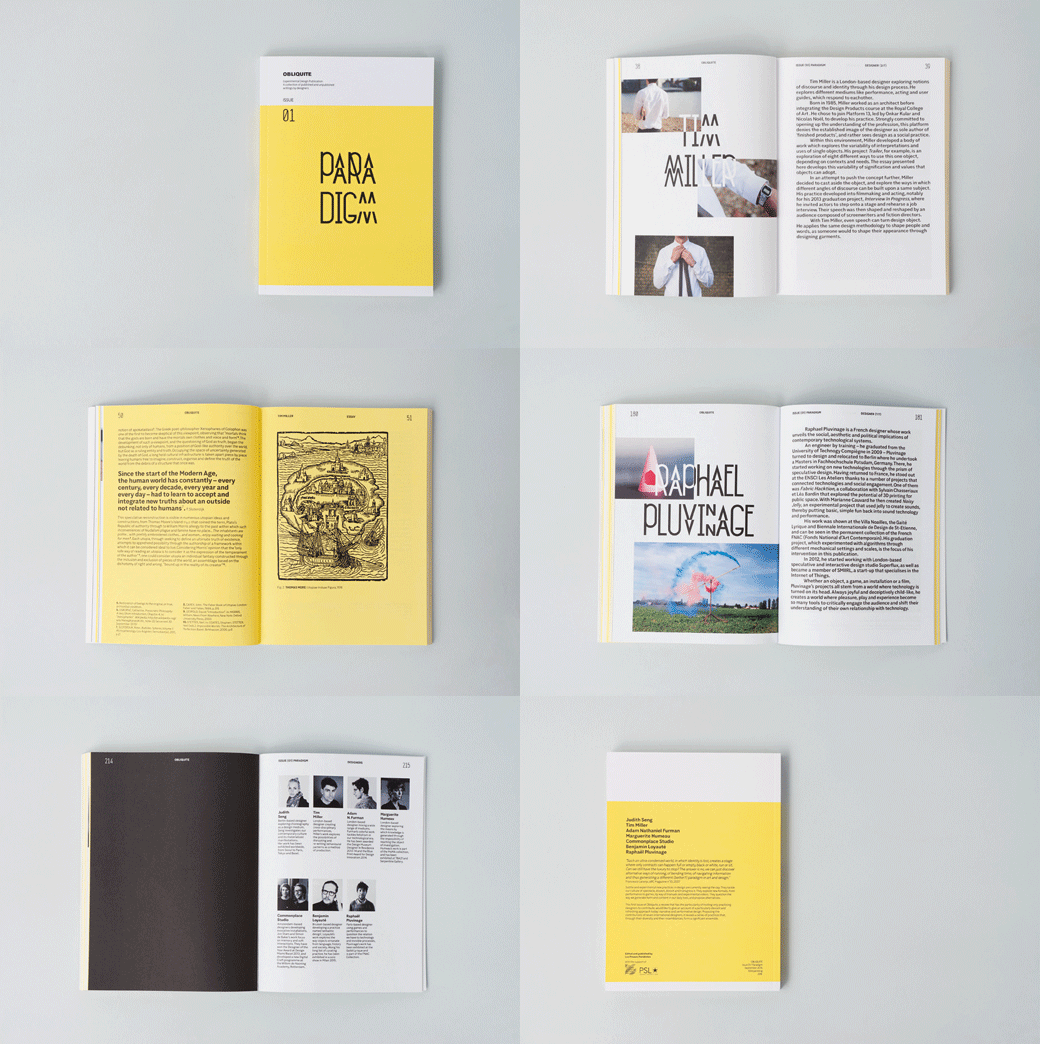
Obliquite is a design research journal inviting practitioners to publish texts and share their tknowledge through interviews. Its aim is to unviel what Nigel Cross called “a designerly way of knowing”.
The first issue invites designers exploring installations, performance or games as their design medium. It questions the reasons for the choice of these mediums, their inspirations, their standpoint towards the design world. The title (Paradigm) refers to a conference of Giorgio Agamben looking at the way singular examples of practices can influence a whole disciplinary field.
With texts and works by Judith Seng, Tim Miller, Adam Nathaniel Furman, Marguerite Humeau, Commonplace Studio, Benjamin Loyauté Studio and Raphaël Pluvinage.
2015 - 240p - edited by LPP. To get a copy, contact us.
Editorial direction
-
Introduction : A recent paradigm shift in materials science and engineering has taken place. The conventional emphasis on strength, durability, and stability generates objects that are difficult to recycle and therefore directly linked to the current ecological crisis. Consequently, researchers in design, engineering, and architecture are now turning their attention to the evolutionary, self-healing, multifunctional, and active capacities of materials that behave just like living organisms. However, in living organisms, these mechanisms are often guided and orchestrated by dendritic or vascular typologies, which support metabolic functions, based on fluid circulation, and the optimization of interactions with the environment.
Visual essay in .able journal, 2024.
-
Abstract : The ecological crisis alerts us first and foremost to the importance of materials in their evolving, complex and ubiquitous aspects. It forces us to consider the kinds of materials, structures and processes we use. It urges us to re-materialise things, to think them as flows, to trace the ecological, economic, political and social connections that underlie them. In this sense, the ecological crisis fundamentally challenges the role of the designer. The changes that this crisis is forcing on the field of design, be it with regard to their instruments, their modes of expression, their creations, or their values, extend far beyond the consideration of the ecological impact of a product or the use of "natural" materials. In the following, I present some reflections based on my experience as an engineer and designer to then propose a distinction between material and matter, and finally outline some contemporary strategies for the relationship between the designer and its materials.
In DAM, Collectif (dir.), Matière/Matériau(x)/Médium: des controverses fécondes, Revue Design Arts Medias, 11/2023.
-
Introduction: The ecological crisis gives materiality a new status – it regains its importance and requires our full attention, with its physical, social, technical, political and anthropological dimensions. From now on, there is no way to silence matter and con- sider it stable and mute – its activity manifests it- self everywhere. The development of the new geo- logical layer created by humans seems inescapable, even if we try to limit its effects by reducing our footprint, or recovering our waste. We respond to the problem with a series of new technological fix- es, which, in the end, are part of the same logic of efficiency as the industries that created the prob- lem itself. How can design, when it addresses man- ufacturing processes, provide alternatives? How can it allow for diversifying our technical futures and at the same time question our relationship to materials? In this chapter, I will expose some thoughts on material activities based on my own design practice and emphasize the crucial role of design in the understanding, and living with, active matter.
In Let’s Get Sustainable, Art, Design and Architecture, Frye, Anika et al. (eds), Verlag fur Moderne Kunst, Wien, 2023.
-
Introduction: The practice of design is among the disciplines generating the most dramatic consequences for our environment. The will to build stable, perennial objects crossing time, combined with a strategy for constant renewal, programmed obsolescence, and trend generation is at the heart of the waste problem as much as the legacy of designers’ actions. How to question this fate and develop alternative strategies? If a circular economy and bio design is the current answer, different approaches could be explored. The ecological crisis is essentially a temporal issue. It forces us to analyze the consequences of our actions over thousands of years. At the same time, however, it is a great acceleration, where every year counts, and the choices for drastic change have become stressfully urgent. The project presented in this article tries to take a different stance toward our legacy to future generations with a desire to act in the present. Entitled “petrification,” this research has given rise to more than seven years of material and conceptual explorations. Started as a very pragmatic method to generate a new local craft, it then led to question the relations between organic and inorganic matter, the symbolic power of petrification as a material and cultural transformation, and the relations between technicity and culture through an interpretation of Gilbert Simondon’s theory of technology. This research project has been essentially an investigation, full of discoveries, twists and turns. In the following pages, I will give an account of this situated investigation and its multiple facets.
In Perraudin Léa, Winkler, Clemens, Mareis, Claudia, Held, Matthias (ed.), Material Trajectories: Designing With Care?, Annual Conference Proceedings DGTF, 2022.
-
This article takes the shape of an interactive visual essay on a specific journal called .Able.
Introduction: Petrification is a process of transformation from cellulose to rock, making it possible to imagine a ceramic artifact with a simple shape, from paper, rope, cotton, wood, or cardboard. It consists of two stages: the infusion of a silica solution into the model, followed by atmospheric pyrolysis. During this firing, carbon, and silica fuse to form silicon carbide, a rigid and abrasive ceramic, technically comparable to that of a diamond. This project—developed by Emile De Visscher in collaboration with scientists from ESPCI (Jérôme Bibette), UPMC (Florence Babonneau), Chimie ParisTech (Philippe Barboux), ENSAD (SACRe, l’Université PSL), and Humboldt Universität (Cluster Matters of Activity) —combines experimental scientific development with research through design to imagine an innovative artisanal manufacturing process.
In .able journal, 2023.
-
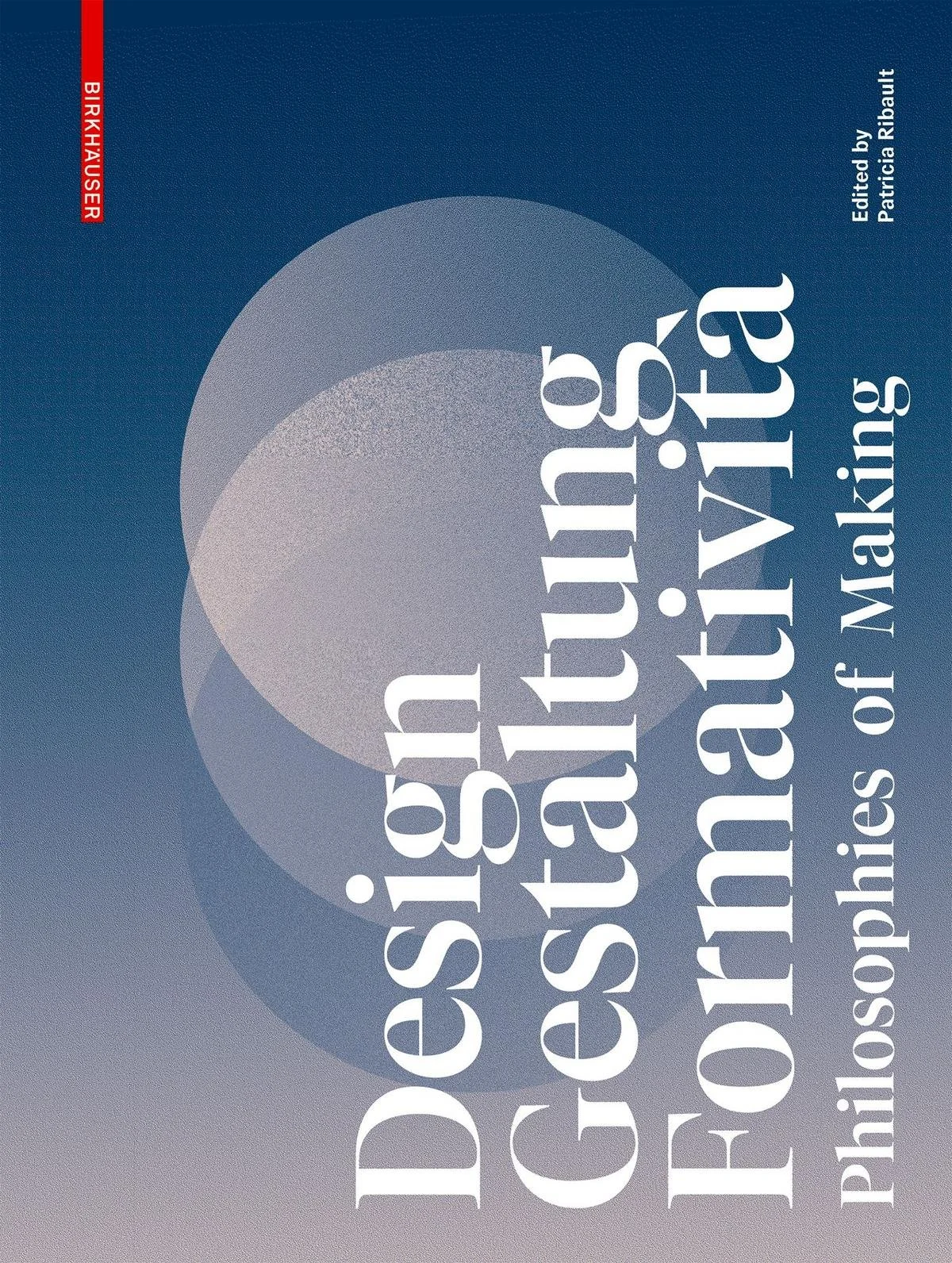
Introduction: Where do our consumer goods come from? What materials are they made of? How much energy do they consume? How far have they traveled? What waste products do they leave behind them? The contemporary ecological emergency urges us to take a closer look at the manufacturing processes of our material goods and examine their ecological impact. Instead of the environment being seen as a place made of thousands of forms and products people live among, it is worthwhile considering it as constituted of countless formations and productions. From this angle, material, long thought of as stable, isomorphic, predictable, solid, is replaced by matter—composite, evolving, perishable, malleable, and corrosive. In this way, the world gains in dynamism and matter reasserts its rights and its history.
In Patricia Ribault (ed.), Design Gestaltung Formativita, Birkhauser, 2022.
-
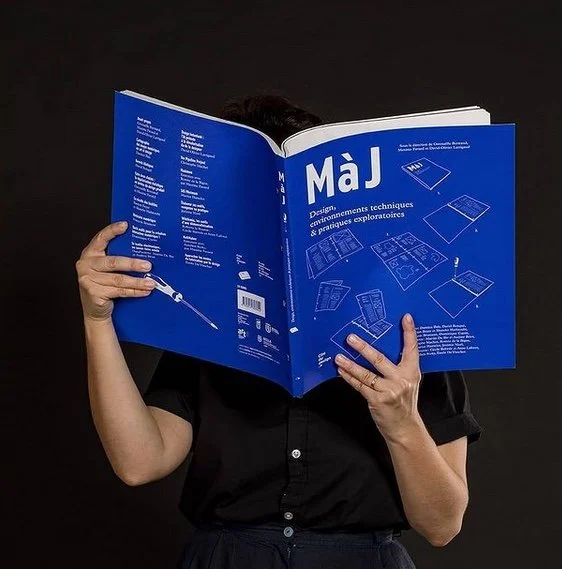
Abstract: While design has historically been devoted to industrial tools, recent years have seen a proliferation of projects that invent, tinker, transform, and question manufacturing methods. New sustainable materials, surprising machines, semi-artisanal techniques, biodesign, in situ creations, random processes, and other repurposed 3D printers have invaded trade shows, exhibitions, and diploma projects. In my opinion, the potential of such an exploration of means through design is fundamental. It is not limited to a search for formal singularity or independence from the industrial system. Behind designers' appropriation and conception of manufacturing processes lies a desire to transform the relationship between technology and society.
In Gwenaëlle Bertrand, Maxime Favard et David-Olivier Lartigaud (eds), MàJ : design, environnements techniques & pratiques exploratoires. Cité du design/Esadse, 2021.
-
with Iva Resetar and Lorenzo Guiducci (Humboldt Universität zu Berlin).
Abstract: Following a long series of transfers from material behavior and ecology, the notion of resilience is today a general concept in systems thinking for ecology, cybernetics and information theory. Recent debates around the ubiquitous use of the term necessitate a renewed enquiry into its implications. This article proposes a case-specific, interdisciplinary approach to resilience by reconstructing its initial links to materiality. Through the lens of biological material sciences, architecture and design, our three studies will investigate the materiality of resilience as opposed to isotropy, inertness and durability, revealing how it is embedded in the context. Building up from the material base of resilience, we argue for the agency of resilient materials and technologies in the development and organization of projects and propose connections between the resilience of materials and that of social, political and ecological systems.
Conference proceedings of Cumulus Roma 2021. Accessible upon request.
-
PhD thesis, under the direction of Samuel Bianchini (ENSAD) and Roger Malina (Texas University).
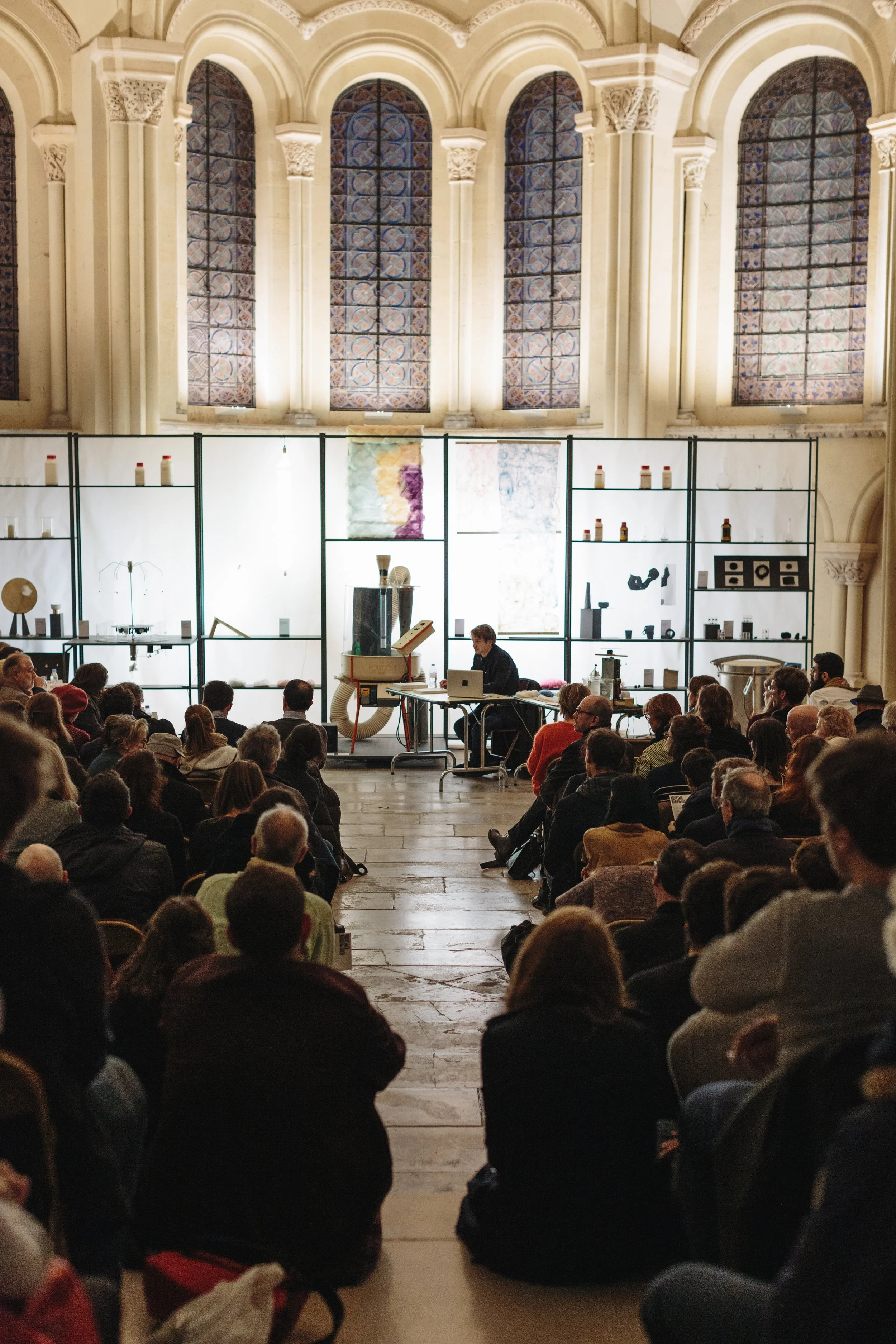
Abstract: The environmental crisis demands a closer look at the origin of things. Today, we barely know the provenance of the objects we buy and use on a daily basis, nor how they are made and how much energy they require. We don’t have access to their “ecologies”. This lack of knowledge keeps the environmental issues at stake out of reach, it “de-responsibilisates” us. Recent design movements have developed a more open, small-scale and accessible vision of production processes. They seek to democratize, share, and educate towards the understanding and participation to the making of things. Though crucial, these movements are limited by the fact that they only develop and present these new inventions as alternative means. The thesis claims that the socialisation of production provides a unique occasion to rethink our relation to technologies and artefacts. This practice-based design research explores the conditions through which new manufacturing processes fully take into account the symbolic and aesthetic aspects that allow people to endorse the problems at stake, not only through use and efficiency, but also through sensation, imagination and wonder. This cultural approach to technologies has been named by Gilbert Simondon “Technophany”, in direct reference to Mircea Eliade’s “Hierophany”, which described the equally symbolic and efficiently driven relation to tools and processes that many non-Western people have developed and kept alive. These “technophanic manufactures” seek to “make us love technicity again” to become public things, “res publica” - able to enrol communities around the awareness of its uses and impacts. To do so, a design approach is necessary, in order to include technical, symbolic, aesthetic, scientifi and practical ways of thinking. It seeks to translate hidden realities into accessible and participative experiences.
PhD thesis in the SACRe Program, PSL University, held at ENSAD Paris, under the direction of Samuel Bianchini and Roger Malina, 2018.
ARTICLES ON technology and materials
ARTICLES ON DESIGN AND METHODS
-
Deep Materialities - investigating the complex socio-technical entanglements of materials towards the designing of resilient futures.
With James Auger.
Abstract : Each material production entails an ecosystem of interrelations linking geopolitical, economic, technological, cultural, social and sanitary dimensions, sometimes on a global scale. As designers, we are rarely conscious of these realities, and limit our actions to material selection at the scale of the artefact in constrained industrial and cultural settings. However, at a time of ecological crisis, tracking, revealing and understanding these complex systems is becoming an imperative if we are to transition towards resilient futures rooted in socio-economic realities. This article will present a pedagogical approach developed with Design Research MA students, where investigation and speculation stem from a given material. The authors discuss the types of issues encountered, such as the study of "proprietary materials", "promising materials" and "information materials", as well as ways to extend and deploy this approach in other educational or research contexts.
De Visscher, E., and Auger, J. (2026) Deep Materialities - investigating the complex socio-technical entanglements of materials towards the designing of resilient futures, in Simeone, L., Gray, C. M., Verhoeven, A., de Götzen, A., Bakırlıoğlu, Y., Zohar, H., Stead, M., and Buwert, P. (eds.), DRS2026: Edinburgh, 8–12 June, Edinburgh, United Kingdom. https://doi.org/10.21606/drs.2026.2020
-
Design Dark Matter - Revealing and Transforming Production ecologies.
Abstract : In the age of ecological crisis, the production of an object has become a societal issue, a matter of choice. Should we consume these energies and materials? What losses, pollution, and waste are generated, and are they commensurate with the service provided by the object produced? !ese questions have become collective and crucial today. However, all production and its constraints (container ships, machines, quarries, factories, fields) as well as laboratories, financing models, networks of influence, and legal standards, and the very conditions of existence of all our everyday objects, are invisible (Hackenschmidt, 2016). As citizens, it is very difficult to grasp the constraints and impacts of our consumption choices. That is why designers today are using research to reveal what the production of objects entails — its technical, legal, ecological, economic, historical, and political underpinnings. Emerging practices, particularly in research, focus less on the objects that result from these constraints and more on how these constraints themselves can be redefined.
in Azimuts Research Art Design n°61, “Why continue to produce objects today ?”, Cité du design - Esadse, 2026, pp. 123-130.
https://www.citedudesign.com/en/a/azimuts-research-art-design-n61-3824
-
Abstract : While it is widely accepted that the industrial production system is one of the key factors behind the climate crisis, alternatives to it are not easy to develop. Not only do they require renewed creativity, but they also raise particularly complex questions in terms of their evaluation criteria, territorialization, and the scales and timeframes they involve. Ultimately, this transformation requires us to question the very concept of technical efficiency, which is central to engineering and all innovation professions. In this context, designers can be a driving force, as their experience makes them better able to integrate other parameters into the design process, rather than those based solely on economics, efficiency, or stability. This text provides an opportunity to describe a number of research experiences and defend the practice of designing production processes as a driver of diversification in our productive ecologies.
In David Enon (ed), LOW/SLOW Production, T&P Workunit, 2025.
-
Introduction : How are we to deal with the issue of the fake in design without automatically ascribing a negative value to subterfuge? How do we escape those binary categorisations that would set real causes against false pretences? How do we approach the manufacturing of truth on neutral ground without creating a division between rational scientific knowledge and fantastical belief? To help us answer these questions, French intellectual Tobie Nathan can point us in the right direction. A key figure in French ethnopsychiatry and Professor Emeritus of Psychology at Université-Paris VIII, he is also the founder of the Centre George Devereux which provides psychological support for immigrants. Throughout their 30 years of working with this unique patient group, Nathan and his colleagues have gradually constructed new care protocols which, rather than stigmatizing immigrants’ beliefs, objects of worship and supernatural entities, actively welcome them and seek to understand and work with them. This article is an extract from “Nous ne sommes pas seuls au monde” [We Are Not Alone in the World], whose title acknowledges the existence and efficacy of objects and entities such as Djinns, ghosts, the dead, witches, abikus (African invisible non-humans) and demons. He studies the effects and workings of amulets, fetishes and sacrifices, on a par with modern science’s drugs.
In Emile De Visscher and LPP (eds), RADDAR #4 - Faux/Fakes, MUDAC and T&PWorkunit, Lausanne and Paris, 2022.
-
Introduction: Through teaching, one can witness young designers adopting a radical critical stance towards consumerism, capitalism and mass-production logic. But how to express and perform this criticality through design projects without being trapped in contradictions? How to keep the solution-driven, democratic, embodied characters of design along a sharp criticism of society and technology? The speculative approach developed by Anthony Dunne and Fiona Raby within the Design Interaction Master’s program at the Royal College of Art has been a successful and influential answer. But aside from these “provocative, purposely simplified and fictional” (Dunne & Raby, 2013: 3) technological futures using “dark design” scenarios (Dunne & Raby, 2013, 38–43), which alternative critical design approaches have emerged recently? More specifically, can design criticality be found in deployable, contextual, functional proposals? Three recent design projects will be analysed in this article. The aim of this investigation will be to test a hypothesis: new forms of critical design are currently emerging – inheritors of certain achievements, but focusing on the present rather than the future, on ambiguity rather than dystopia, and on participation rather than aesthetic appreciation.
In Claudia Mareis, Moritz Greiner-Petter, Michael Renner (eds), Critical by Design? Genealogies, Practices, Positions, Transcript Verlag, 2020.
-
Introduction: Everything can serve. It goes without saying that we can, not only correct a piece or integrate different fragments of outdated pieces in a new one, but even change the meaning of these fragments and rig, in any form we will judge necessary, what fools persist on calling quotations. Guy Debord, 1958
The idea of taking someone’s work and transforming it for one’s own purpose is probably one of the oldest practices in our History. However, since the creation of the concept of authorship and the recognition of that as a form of ownership, transforming other people’s works has become a statement, a way to subvert and recreate new content. But remixing is different than a simple quotation. It uses the material of the piece itself: it destroys its integrity, transforms its content, and gives a new order to that previous piece. Instead of working with raw materials, remixing engages with previously informed content - it shapes it differently and gives it a new purpose.
Text for the exhibition catalog “Remix : a new way of Making”, curated by Ben Allun Jones, for Frameless Gallery, London, 2012.
Accessible upon request.
-
Introduction: “One day, perhaps, the century will be Deleuzian” Michel Foucault once declared. Gilles Deleuze is considered as one of the major philosophers of the 20th century. His books are mines of ideas that have influenced many creative fields, to such an extent that they can sometimes appear too prolific and complex. In 1969, Gilles Deleuze published Difference and Repetition, his first book not related to the study of other philosophers. The theses presented then are precursory to the changes happening now in manufacture and design. I will try to explain how and why this incredible work is still relevant in the contemporary design field over 40 years after its release.
Text for the online magazine Unmaking Things, curated by RCA's History of Design students, 2012.
-
Introduction: The aim of this dissertation is not to settle a definition of design, nor to define its difference with art. Those question are too vast and contradictory. It will just show and try to elucidate one kind of design and art process that I feel is important, firstly because it is actual (more and more designers are using it and thinking about it), secondly because it is a reaction to the general tendency of having control over life. Everything is designed now, from objects to transport, services and communication. Everything is pre-thought, contained, Pre-maché. “Everyday life becomes more and more artificial and theatralized”1. Just to give a example, a big case that enlightened this phenomenon came from Douglas Bowman, former head of visual design at Google, who left his job because of “data-centrism”. On his blog, we could read: “Yes, it’s true that a team at Google couldn’t decide between two blues, so they’re testing 41 shades between each blue to see which one performs better. I had a recent debate over whether a border should be 3, 4, or 5 pixels wide, and was asked to prove my case.”2 We won’t go further to show that design and other fields of companies like marketing and publicity are all about defining pre-designed experiences. Many people around the world are analyzing and criticizing this phenomenon (Baudrillard, Debord, or more recently Zizek among others). We won’t come back to these critics, not because they are not crucial, but because as designers, we should take them into account and overcome them with new creations.
MA dissertation, Royal College of Art, 2012.
1 _ Emile De Visscher, Article for Mises à Jour, Design, environnements techniques et pratiques exploratoires, 2021. Credits: Camille Chatelaine.
2 _ PhD defense, ”Manufactures Technophaniques”, CNAM, PSL Univ, ENSAD, 2018. Credits Photo: Palta Studio.
3 _ RADDAR, design research journal, #4 : Fake, Faux, Editorial direction, w. LPP, 2022.
4 _ Obliquite, First issue : PARADIGM, Editorial direction, LPP, 2015.
5 _ Article for Design, Gestaltung, Formativita, Philosophies of Making, Edited by Patricia Ribault, Birkhauser, 2022.